Hepatitis
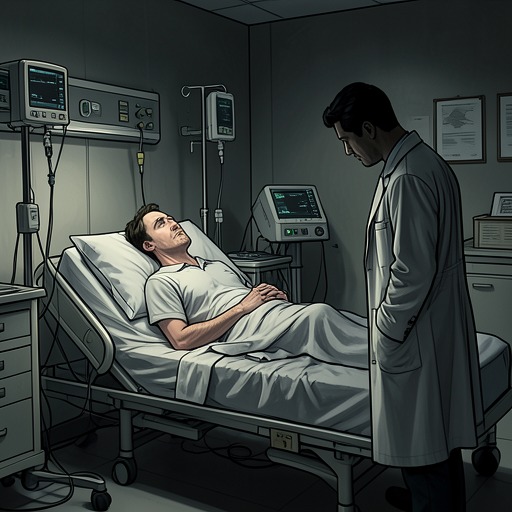
The ReaderMichael Berg’s hepatitis is the illness that frames his first encounter with Hanna Schmitz and helps shape the conditions under which their relationship begins. It weakens him over the autumn and winter, keeps him from school, and confines him to a sickroom; during his first outing, his physical vulnerability leads to Hanna’s intervention. The illness is therefore more than an opening diagnosis: it makes dependence and care part of the story’s earliest account of desire, while the adult narrator’s recollection turns convalescence into a meditation on memory and isolation.
Onset, Symptoms, and Diagnosis
Michael is fifteen when he contracts hepatitis. It begins in the fall and lasts until spring. As the weather grows colder, his strength declines; the symptoms make ordinary actions difficult. Walking is an effort, and stairs at home or school can seem beyond what his legs can manage. He loses his appetite, feels nauseated even when he sits down hungry, and wakes with a dry mouth and a heavy, disoriented sense of his own body. His first vomiting episode occurs on the way home from school, on Bahnhofstrasse. He is ashamed both of his weakness and of being unable to control what happens to him.
The episode brings a stranger into his story. A woman takes hold of his arm and leads him into a courtyard, where she washes him and helps clean the pavement. When she notices that he is crying, she comforts him, then walks him home with his schoolbag and supports him along the way. The care is practical and decisive: Michael is too unwell to manage the situation alone, and the woman’s intervention turns an exposed, humiliating moment into the beginning of a connection. His mother calls a doctor that same day, and the doctor diagnoses hepatitis.
Confinement and Convalescence
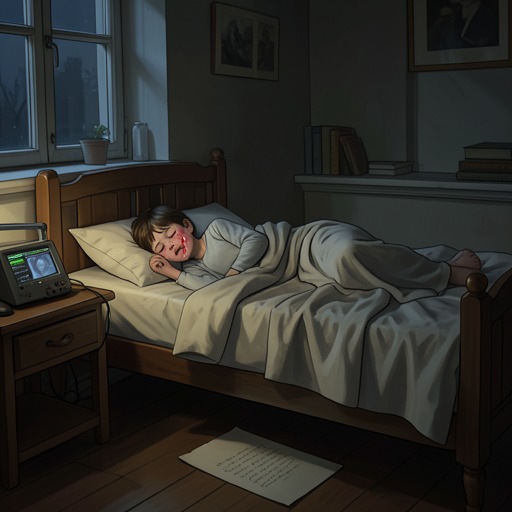
The illness keeps Michael away from school after the diagnosis. At first, the worsening of his condition gives way to gradual improvement: in January, during a warm spell, his mother moves his bed onto the balcony. He can see the sky, sun, and clouds, and hear children playing in the courtyard. In February, at dusk, he hears a blackbird singing. These moments mark a change in his circumstances, but not a return to ordinary life. He remains confined and under medical direction, and his recovery proceeds slowly.
During this period, Michael’s mother encourages him to thank the woman who helped him. When he is well enough, she expects him to use his pocket money to buy flowers and introduce himself. By the end of February he sets out for Bahnhofstrasse. The illness has thus shaped the circumstances of their meeting twice over: first by leaving him in need of help in the street, then by prompting the visit that brings him back to the woman’s home. His body is recovering, but his return to the world is still tentative and guided by others.
The Sickroom as a World
Looking back, Michael describes childhood illness as an interval in which the outside world recedes to a distant murmur. Books fill the sickroom with characters and stories, while fever sharpens imagination even as it weakens ordinary perception. Familiar furniture seems to take on unfamiliar forms, and nights stretch around the church clock and the occasional sound of a passing car. In this recollection, the sickroom is not simply an empty space between sickness and health: it becomes a distinct inner world where desire, memory, fear, and possibility gather.
Recovery does not immediately end that confinement. Michael observes that a long illness can leave the sickroom seemingly saturated with its former atmosphere; even after the fever has passed and the patient is convalescing, the mind may remain caught in its labyrinth. His account distinguishes the body’s improvement from the slower change in perception and feeling. That difference helps explain why the end of the acute illness does not restore him at once to the uncomplicated routines of school, friends, and ordinary time.
From Illness to Attachment
Michael’s convalescence also leaves him bored, without school, and increasingly separated from his friends’ daily lives. Their visits grow shorter, and books have lost some of their power to occupy him after months of reading. He is supposed to take progressively longer walks without overexerting himself, but feels he could use more exertion. In that enforced vacancy, his thoughts return to Hanna. A week after first going to her door, he is back there again.
After their relationship begins, illness remains part of the way Michael understands his emotional response. The night after their first sexual encounter, he falls in love with Hanna and cannot sleep; he remembers yearning for her and wanting to be with her. The narrative places this attachment after a period in which he has been physically weak and reliant on care, but it does not reduce his feelings to the disease or offer a single explanation for them. Instead, the movement from sickness and dependence to longing gives the beginning of the relationship a bodily and temporal context: Michael is emerging from a long interruption in his life just as Hanna becomes its new focus.
Aftermath and Retrospective Meaning
When Hanna later leaves the city, Michael’s recovery from the illness and his separation from her become distinct but connected experiences. He recalls watching for her, finding that afternoons had lost their shape, and feeling his body reach for her in sleep. He avoids her building and takes other routes; six months later, his family moves to another part of town. The account contrasts these lingering effects with the gradual ending of the hepatitis itself: while the illness belongs to his adolescence, the habits of memory and attachment do not end when the symptoms do.
As an adult narrator, Michael returns to the illness through details of duration, place, care, and sensory perception, but also through reflection on how memory preserves or rearranges experience. The illness marks the beginning of his story with Hanna and supplies its first pattern of vulnerability, rescue, and return. Its significance lies not in a claim that sickness determines what follows, but in the concrete circumstances it creates: an isolated teenager, a carefully managed convalescence, and the first encounter that becomes inseparable from his recollection of growing up.